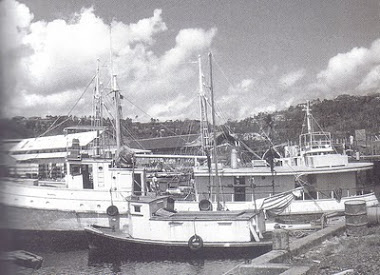
The Joyita was a yacht that belonged to Roland West and was used in the 1931 movie CORSAIR. This was the movie in which Thelma Todd was billed as "Alison Loyd".
The movie was not a success. But greater misfortunes for the Joyita were yet to come.
MV Joyita
From Wikipedia, the free encyclopedia
MV Joyita was a
merchant vessel from which 25 passengers and crew mysteriously disappeared in the
South Pacific in 1955. It was found adrift in the South Pacific without its crew onboard. The ship was in very poor condition, including corroded pipes and a radio which, while functional, only had a range of about 2 miles due to faulty wiring. Despite this, the extreme buoyancy of the ship made sinking nearly impossible. Investigators were puzzled as to why the crew didn't remain on board and wait for help.
Vessel description and history
Construction
The 69-foot (21 m) wooden ship was built in 1931 as a
luxury yacht by the Wilmington Boat Works in Los Angeles for
movie director Roland West. During this period, she made numerous trips south to Mexico and to the 1939-40
Golden Gate International Exposition in San Francisco. During part of this time, Chester Mills was the skipper of the vessel.
U.S. Navy service in World War II
After the
attack on Pearl Harbor, she was acquired by the
United States Navy and taken to
Pearl Harbor, Hawaii, where she was outfitted as Patrol Boat
YP-108. (Another YP-108 sank near Pearl Harbor, not the
Joyita). The Navy used her to patrol the big island of Hawaii until the end of World War II.
Private purchase
Dr. Katharine Luomala, a professor at the
University of Hawaii, bought the ship in 1952 and chartered the boat to her friend, Captain Thomas H. "Dusty" Miller, a British-born sailor living in
Samoa. Miller used the ship as a trading and
fishing charter boat.
The incident at sea
Overdue and disappeared
About 5:00 AM on October 3, 1955, the
Joyita left Samoa's Apia harbor bound for the
Tokelau Islands, about 270 miles (430 km) away. The boat had been scheduled to leave on the noon tide the previous day but her departure was delayed because her port engine
clutch failed. The
Joyita eventually left Samoa on one engine. She was carrying 16 crew members and 9 passengers, including a government official, a doctor (
Alfred "Andy" Denis Parsons, a World War II surgeon on his way to perform an amputation), a
copra buyer, and two children. Her cargo consisted of medical supplies, timber, empty oil drums and various foodstuffs.
The voyage was expected to take between 41 and 48 hours. She was scheduled to return with a cargo of
copra. The
Joyita was scheduled to arrive in the Tokelau Islands on October 5.
On October 6 a message from
Fakaofo port reported that the ship was overdue. No ship or land-based operator reported receiving a
distress signal from the crew. A
search and rescue mission was launched and, from 6 to 12 October, the
Sunderlands of the
Royal New Zealand Air Force covered a probability area of nearly 100,000 square miles (260,000 km²) of ocean during the search. But no sign of the
Joyita nor any of her passengers or crew were found.
Sighted off-course without passengers or crew
Five weeks later, on November 10, Gerald Douglas, captain of the merchant ship
Tuvalu, enroute from
Suva to
Funafuti sighted the
Joyita more than 600 miles (1,000 km) from her scheduled route. The ship was partially submerged and listing heavily (her port deck rail was awash) and there was no trace of any of the passengers or crew; four tons of
cargo were also missing. The recovery party noted that the radio was discovered tuned to
2182 kHz, the international marine
radiotelephone distress channel.
Condition of the vessel
- Barnacle growth high above the usual waterline on the port side showed that the Joyita had been listing heavily for some time.
- There was some damage to the superstructure. Her flying bridge had been smashed away and the deckhouse had light damage and broken windows. A canvas awning had been rigged on top of the deckhouse behind the bridge.
- The starboard engine was found to be covered by mattresses, while the port engine's clutch was still partially disassembled, showing that the vessel was still running on only one engine.
- An auxiliary pump had been rigged in the engine room, mounted on a plank of wood slung between the main engines. However, it had not been connected.
- The radio on board was tuned to the international distress channel, but when the equipment was inspected, a break was found in the cable between the set and the aerial. The cable had been painted over, obscuring the break. This would severely limit the range of the radio to about 2 miles (5 km).
- The electric clocks on board (wired into the vessel's generator) had stopped at 10:25 and the switches for the cabin lighting and navigation lights were on, implying that whatever had occurred happened at night. The ships' logbook, sextant, mechanical chronometer and other navigational equipment were missing.
Although the
Joyita was found with her
bilges and lower decks flooded, her hull was sound. When she was moored back in harbour at
Suva, investigators heard the sound of water entering the vessel. It was found that a pipe in the raw-water circuit of the engine's
cooling system had failed due to
galvanic corrosion, allowing water into the bilges. The first the crew would have known about the leak was when the water rose above the engine room floorboards, by which time it would have been nearly impossible to locate the leak. Also, the bilge pumps were not fitted with
strainers, and had become clogged with debris, meaning that it would have been very difficult to pump the water out.
Maritime inquiry
A subsequent inquiry found that the vessel was in a poor state of repair, but determined that the fate of the passengers and crew was "inexplicable on the evidence submitted at the inquiry". An especially inexplicable point was that the three
liferafts the
Joyita carried were missing, but it would not make sense for the crew and passengers to voluntarily abandon the vessel. Fitted out for carrying refrigerated cargo, the
Joyita had 640 cubic feet (18 m
3) of
cork lining her holds, making her virtually unsinkable. In addition, further
buoyancy was provided by a cargo of empty fuel drums.
The inquiry was only able to establish the reasons for the vessel becoming flooded. It found that the vessel would have begun to flood due to the fractured cooling pipe. The bilge pumps were unserviceable due to becoming blocked. The
Joyita lacked watertight bulkheads or subdivisions in the bilges. The water would have gradually flooded the lower decks. As the vessel began to sink lower into the water, the one remaining engine would not have been able to maintain enough speed to steer. The
Joyita then fell beam-on to a heavy swell and took on the heavy list it was found with. While flooded to an extent which would sink a conventional vessel, the
Joyita stayed afloat due to her cork-lined hull and cargo of fuel drums.
The inquiry also placed much of the responsibility for the events on Miller. They found him reckless for setting out on an ocean-going voyage with only one engine and numerous minor faults, and negligent for failing to provide a working radio or properly equipped
lifeboat. He was also in breach of maritime law, since he had allowed
Joyita's license to carry fare-paying passengers to lapse.
The inquiry made no mention of the used medical equipment found on board.
Theories
The
Joyita is sometimes referred to as the "
Mary Celeste of the South Pacific" and has been the subject of several books and
documentaries offering explanations that range from rational and conventional to supernatural and paranormal.
[citation needed]
Numerous theories for the disappearance of the
Joyita's crew and passengers have been advanced. Many were circulated at the time of the event, and several others have been put forward since.
[citation needed]
Given the fact that the hull of the
Joyita was sound and her design made her unsinkable, a main concern of investigators was determining why the passengers and crew did not stay on board if the events were simply triggered by the flooding in the engine room.
[citation needed]
Captain injured theory
Captain Miller was well aware of the vessel's ability to stay afloat, leading some to speculate that Miller had died or become incapacitated for some reason (someone on board was injured- hence the bloodstained bandages). Without him to reassure the other people on board, they had panicked when the
Joyita began to flood and had taken to the liferafts. However, this in itself would not account for the missing cargo and equipment, unless the vessel had been found abandoned and had her cargo removed.
A friend of Miller's, Captain S. B. Brown, was convinced that Miller would never have left the
Joyita alive, given his knowledge of her construction. He was aware of tension between Miller and his American first mate, Chuck Simpson. Brown felt that Miller and Simpson's dislike of each other came to blows and both men fell overboard or were severely injured in a struggle. This left the vessel without an experienced seaman and would explain why those remaining on board would panic when the ship began to flood.
The "Japanese did it" and the piracy theories
The
Fiji Times and Herald quoted at the time from an "
impeccable source" to the effect that the
Joyita had passed through a fleet of Japanese
fishing boats during its trip and "had observed something the Japanese did not want them to see." Others theorize that
modern sea pirates attacked the vessel, killed the 25 passengers and crew (and cast their bodies into the ocean), and stole the missing four tons of cargo.
The Daily Telegraph theorised that some
still-active Japanese forces from World War II were to blame for the disappearances, operating from an isolated island base.
There was still strong anti-Japanese feeling in parts of the Pacific, and in Fiji there was specific resentment of Japan being allowed to operate fishing fleets in local waters. Such theories suddenly gained credence when men clearing the
Joyita found knives stamped 'Made in Japan'. However, tests on the knives proved negative and it turned out the knives were old and broken- quite possibly left on board from when the
Joyita was used for fishing in the late 1940s.
Insurance fraud theory
It was also revealed that Miller had amassed large debts after a series of unsuccessful fishing trips on
Joyita. However, it would have been difficult to see the events surrounding the
Joyita as
insurance fraud, given that no
seacocks were found open and the ship would be almost impossible to
scuttle. Also, Miller was relying on
Joyita being chartered for regular runs between
Samoa and
Tokelau- these government charters would have quickly cleared his debts.
Mutiny theory
One of
Joyita's owners after the events of 1955, travel-writer
Robin Maugham, spent many years investigating his vessel's past, and published his findings as
The Joyita Mystery in 1962. Maugham agreed that events were started by the flooding from the broken cooling pipe and the failure of the pumps. The mattresses found covering the starboard engine were used either in an attempt to stem the leak or to protect the electrical
switchboard from spray kicked up by the engine's
flywheel as the water level rose. At the same time, the
Joyita encountered increasingly heavy swells and
squally weather.
Miller, knowing the
Joyita to be unsinkable and desperate to reach his destination to clear his debt, pressed on. However, Simpson, and possibly other crew members, demanded that he turned back. This effectively led to
mutiny and Miller and the crew struggled, during which Miller sustained a serious injury. By now the ship was entering heavier weather, with winds around 40 mph (64 km/h), and with one engine and a flooded bilge, was beginning to labour. The flooding in the engine room would have eventually caused the starboard engine to fail, also cutting all the vessel's electrical power. Simpson was now in control and made the decision to abandon ship, taking the navigational equipment, logbook and supplies, as well as the injured Miller, with them. It still seems unlikely that Simpson would choose to abandon a flooded but floating ship to take to small open rafts in the Pacific Ocean.
Maugham proposed that they sighted a nearby island or
reef and tried to reach it, but in the strong winds and seas the rafts were carried out to sea, leaving the
Joyita drifting and empty. The damage to the lightly built superstructure was caused by wave damage while the vessel was drifting in heavy seas.
Joyita after 1955
In July 1956,
Joyita was auctioned off by her owners for £2425 to a Fiji Islander, David Simpson. He refitted and overhauled her and she went to sea again that year. However, she was surrounded by legal disputes over the transfer of her registry from the USA to Britain without permission. In January 1957 she ran aground while carrying 13 passengers in the
Koro Sea. She was repaired and in October 1958 began a regular trade between
Levuka and
Suva.
She ran aground again in November, 1959 at Vatuvalu.
[citation needed]
She floated off, but while heading for port, began to ship water through a split seam. The pumps were started, but it became clear that the valves for the pump had been installed the wrong way, meaning that water was pumped into the hull, not out. Now with a reputation as an 'unlucky ship' and with a damaged hull, she was abandoned by her owners and beached. She was stripped of useful equipment and was practically a
hulk when she was bought by
Robin Maugham in the early 1960s.
References
External links
Chief Body at the wheel of the Joyita, 1942
Charlie ( The Cook ) with Thanksgiving Turkey Aboard The Joyita.
WW II US Navy emblem for Joyita, with Bugs Bunny
Joyita listing to one side in the Pacific Ocean after the Passengers and crew vanished in 1955.
Joyita was practically unsinkable, but doesn't look it in these photos.
1958 - Joyita after being salvaged, Walu Bay, Suva
Rate this page
The name "Joyita" is Spanish for "Little Jewel". It was actually named after Jewel Carmen, with whom Roland West was involved. People also associated the Joyita with Thelma Todd and there were stories that when West sold it some of her posessions were still on board. Because the Joyita was supposed to be an unlucky ship, people also thought that Thelma Todd had been a victim of some sort of jinx on the vessel, and because it was used as a patrol boat at Pearl Harbor during World War II, some people linked it to the Japanese attack that flung the US into the war. I would call it coincidence, but ill fortune did befall many people who were associated with the Joyita, some of who aren't mentioned in histories of the vessel. In his autobiography MY WONDERFUL WORLD OF SLAPSTICK, Buster Keaton spoke of going on board the Joyita to talk with Roland West shortly before his career went on the skids.
But everything in life that goes wrong doesn't have to be caused by things like unlucky ships.
The Joyita Mystery, Pt. I:
Joyita Mystery, Pt. II:
Joyita sites:
http://www.creationtrek.com/AVIATION/joyita.htm
http://www.navsource.org/archives/14/31108.htm
Chester Morris
http://www.chester-morris.com/index.php
CORSAIR:
http://www.apocalypselaterfilm.com/2010/09/corsair-1931.html
A