| Dagmar |
|---|
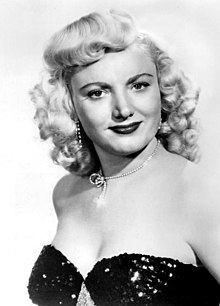
Publicity photo, 1958 |
| Born | Virginia Ruth Egnor
(1921-11-29)November 29, 1921
Yawkey, West Virginia, U.S. |
|---|
| Died | October 9, 2001(2001-10-09) (aged 79)
Ceredo, West Virginia, U.S. |
|---|
| Other names | Virginia Lewis
Jennie Lewis |
|---|
| Occupation | Actress, model, television personality |
|---|
Dagmar (born
Virginia Ruth Egnor, November 29, 1921 – October 9, 2001) was an American
actress,
model and
television personality of the 1950s. As a statuesque, busty blonde, she became the first major female star of television, receiving much press coverage during that decade.
Born in
Yawkey, West Virginia, she went to high school in
Huntington, West Virginia where she was known as
Ruthie. She attended Huntington Business School and worked at
Walgreens as a
cashier,
waitress,
sandwich maker and
soda jerk.
[1]
Broadway bound
After her marriage to Angelo Lewis in 1941, she moved to New York where he was a Naval officer, stationed at Navy Ferry Command on
Long Island. She adopted
Jennie Lewis as her stage name (taken from her real life married name,
Virginia Lewis). To keep busy, she became a fashion photographer's model, and in 1944, other models encouraged her to audition for comedians
Ole Olsen and
Chic Johnson. Although she had no show business experience, she was cast in their Broadway musical revue,
Laffing Room Only, a Shubert production at the Winter Garden Theatre. With Olsen and Johnson, she performed in four sketches from December 23, 1944 to July 14, 1945.
[1]
As a
chorus girl named Bubbles, she appeared with
Bert Lahr in the Broadway comedy
Burlesque, which ran for 439 performances from December 25, 1946 until January 10, 1948. The play was set in the basement dressing-room of a midwest burlesque theater, a New York hotel suite, and a theater in
Paterson, New Jersey.
Television
In 1950, when Lewis was hired by Jerry Lester for
NBC's first late-night show
Broadway Open House (1950–52), he renamed her
Dagmar. Lester devised the name as a satirical reference following the huge success on television of the TV series
Mama (1949–57), in which the younger sister, Dagmar Hansen, was portrayed by
Robin Morgan. As Dagmar, Lewis was instructed to wear a low-cut gown, sit on a stool and play the role of a stereotypical dumb blonde. With tight sweaters displaying her curvy 5' 8" figure (measuring 42"-23"-39"), her dim-bulb character was an immediate success, soon attracting much more attention than Lester. Lewis quickly showed that regardless of appearances she was quite bright and quick-witted. She appeared in sketches, and Lester made occasional jokes about her "hidden talents." Her appearances created a sensation, leading to much press coverage and a salary increase from $75 to $1,250. With Dagmar getting all the attention, Lester walked off his own show in May 1951, and Dagmar carried on as host. On July 16, 1951, she was featured on the front cover of
Life, and the show came to an end one month later.
[2]
Dagmar became one of the leading personalities of early 1950s live television, doing sketch comedy on
Milton Berle's
Texaco Star Theater,
The Bob Hope Show and other shows. On June 17, 1951, she appeared on the
Colgate Comedy Hour with host
Eddie Cantor and guests
Milton Berle,
Phil Foster and Jack Leonard. In 1951, she made a TV guest appearance with
Frank Sinatra,
[3] which prompted
Columbia Records producer
Mitch Miller to record a novelty duet with Frank and Dagmar, "
Mama Will Bark". That same year, she was featured in a
Life cover story with
Alfred Eisenstaedt's photo of her on the July 16, 1951 issue. For the interior photo essay,
Life photographers followed her to rehearsals and accompanied her on a vacation back to her home town in West Virginia.
In 1952, she hosted the short-lived, prime time
Dagmar's Canteen, in which she sang, danced, interviewed servicemen and performed comedy routines. The basic premise of the show was that servicemen from the audience were given roles to act alongside Dagmar in sketches. One of Dagmar's sisters, Jean, was a member of the cast of
Dagmar's Canteen. Jean, who had previously worked as a chorus girl on Broadway, also served as Dagmar's secretary, handling her sister's fan mail, which sometimes soared to 8000 letters a month. When her television show ended, Dagmar performed in
Las Vegas shows and summer stock theater.
Liberace spoke glowingly of her in an interview, stating that she had given him his big break as her accompanist early in his career. In the 1950s, Dagmar was a regular panelist on the
NBC game show,
Who Said That?, along with
H. V. Kaltenborn,
Deems Taylor,
Frank Conniff,
Peggy Ann Garner, and
Boris Karloff. She occasionally made guest appearances on such shows as
What's My Line?,
The Mike Wallace Interview and
Masquerade Party (disguised as
John L. Lewis) and during the 1960s she appeared on
Hollywood Squares,
The Mike Douglas Show and other shows.
[1]
Books
She was one of a number of performers who posed for pictures in the
Patrick Dennis novel
First Lady, published in 1965, as the
soubrette and Presidential
courtesan Gladys Goldfoil.
Personal life
After her marriage to Angelo Lewis ended, she was married to actor
Danny Dayton through much of the 1950s, and then to bandleader Dick Hinds in 1957. After years on the nightclub circuit, she moved to
Ceredo, West Virginia in June 1996 to be near her family. In her last years, she lived with her brother, Bob Egnor, and his wife. Dagmar died in Ceredo, West Virginia on October 9, 2001 of undisclosed causes. She was survived by three sisters, three brothers, an aunt and numerous nieces and nephews.
[4]
Cultural legacy
The
Dagmar bumper is a chrome bullet-point bulge on the front bumpers of
Cadillacs,
Buicks and
Packards built during the 1950s. During the Korean War, a
40 mm self-propelled anti-aircraft tank was named Dagmar's Twin 40s. In the 1950s and 1960s, a blonde female midget wrestler worked as Darling Dagmar, playing off her more statuesque inspiration.
See also
References
External links

-425.jpg)


Q~~60_57.jpg)


