Showing posts with label Howard Hughes. Show all posts

Tuesday, August 21, 2018

Pat DeCicco And His Pals

A


John Austin termed him a "Bootlegger and Pimp for Louis Meyer".

Michael P. Lentz termed him "A louse & sponge if ever there was one."

I would be hard pressed to improve on that, but I can put in a little more.


We'll start with Wikipedia:

Pat DiCicco

From Wikipedia, the free encyclopedia

Pat DiCicco
BornPasquale DeCicco
(1909-02-14)February 14, 1909
Queens, New York, U.S.
DiedOctober 24, 1978(1978-10-24) (aged 69)
New York, New York, U.S.
Other namesThe Glamour Boy of Hollywood
OccupationAgent, movie producer
Spouse(s)
Thelma Todd
(m. 1932; div. 1934)

Gloria Vanderbilt
(m. 1941; div. 1945)

Mary Jo Tarola
(m. 1953; div. 1960)
Pasquale "Pat" DiCicco (February 14, 1909 – October 24, 1978) was an American agent and movie producer, as well as an alleged mobster working for Lucky Luciano.[1] He married and divorced both Thelma Todd and Gloria Vanderbilt. He was a cousin of Albert R. Broccoli and gave him his well-known nickname "Cubby."

Personal life

Todd's marriage in 1932 to DiCicco was particularly unstable and frequently erupted in drunken brawls, one of which resulted in a broken nose for DiCicco and an emergency appendectomy for Todd.[2] They divorced in 1934. Todd died a year later from accidental carbon monoxide poisoning.
At 17 years old, Gloria Vanderbilt went to Hollywood, where she married DiCicco in 1941.[3] DiCicco proved to be a temperamental and abusive husband who called her "Fatsy Roo," and regularly beat her. "He would take my head and bang it against the wall," Vanderbilt said. "I had black eyes."[4] They divorced in 1945.[5]
In 1953, DiCicco married actress Mary Jo Tarola (born February 27, 1928), also known by her stage name, Linda Douglas. The marriage lasted seven years before ending in divorce in 1960.

Ted Healy incident

DiCicco is alleged to have been involved in an altercation with comedian Ted Healy just before the latter's death in 1937.
A source alleged that actor Wallace Beery, producer Albert R. Broccoli, and Broccoli's cousin, agent/producer Pat DiCicco beat Healy so badly that he fell into a coma and died.[6] While there is no documentation in contemporaneous news reports that either Beery or DiCicco was present, Broccoli admitted that he was indeed involved in a fist fight with Healy at the Trocadero.[7] He later modified his story, stating that a heavily intoxicated Healy had picked a fight with him, the two had briefly scuffled, then shook hands and parted ways.[8] In other reports, Broccoli admitted to pushing Healy, but not striking him.[9]
There is disagreement over whether Healy died as a result of the brawl or due to his well-known alcoholism.[1] Because of the authorities' lack of interest in investigating Healy's death, an autopsy was not performed until after Healy's corpse had been embalmed; rendering the examiner's note that Healy's organs were "soaked in alcohol" and useless in determining a cause of death.[1]
Following the autopsy, the Los Angeles county coroner reported that Healy died of acute toxic nephritis secondary to acute and chronic alcoholism. Police closed their investigation, as there was no indication in the report that his death was caused by physical assault.[9]

References

  1. ^ Jump up to: a b c Braund, Simon (June 2010). "The Tragic And Twisted Tale Of The Three Stooges". Empire Magazine. Retrieved 19 August 2015. 
  2. Jump up ^ "Who killed the Ice Cream Blonde?". Santa Monica Daily Press. May 19, 2011. Retrieved 19 August 2015. 
  3. Jump up ^ Vanderbilt, Gloria (2004). ""The Great Thing" (4)". It Seemed Important at the Time: A Romance Memoir. Rockefeller Center, 1230 Avenue of the Americas, New York, NY 10020: Simon & Schuster. p. 31. ISBN 0-7432-6480-0. 
  4. Jump up ^ Last of the big spenders. Telegraph UK 11/23/2004
  5. Jump up ^ Vanderbilt, Gloria. ""Happy Birthday" (6)". It Seemed Important at the Time: A Romance Memoir. New York, NY: Simon & Schuster. p. 36. ISBN 0-7432-6480-0. 
  6. Jump up ^ Fleming, E.J. (2004). The Fixers: Eddie Mannix, Howard Strickling, and the MGM Publicity Machine. McFarland. pp. 174–177. ISBN 978-0-7864-2027-8. 
  7. Jump up ^ staff (December 23, 1937). "Wealthy Sportsman Confesses Fight with Ted Healy". The Oxnard Daily Courier. p. 1. Retrieved May 15, 2013. 
  8. Jump up ^ Cassara, Bill (2014). Nobody's Stooge: Ted Healy. BearManor Media. ISBN 1593937687. 
  9. ^ Jump up to: a b "Ted Healy Died of Toxic Nephritis". Lewiston Evening Journal. December 23, 1937. p. 8. Retrieved May 15, 2013. 


                                             *                                 *                             *


Occasionally we come across the story that Pat DeCicco was working for Lucky Luciano.  There is no proof of this. It is more likely that DeCicco was only a small-timer who was not directly associated with Luciano even though he was involved in the same line of business and started out in the same part of the country.


The imdb has the following trivia item for Pat DeCicco:

Acted as procurer for Howard Hughes and Joseph Schenk while acting nominally as a talent agent.

The association of DeCicco with Howard Hughes is well known, and remarked upon by Jane Russell in her autobiography. She said something to the effect that Howard Hughes didn't want her to become involved with him.

The story about Ted Healy is unproven, as is the allegation that Healy had an affair with Thelma Todd, which is part of the same package. But to get back to Thelma Todd -


It seemed to begin all at once. Thelma Todd and Pat DeCicco suddenly eloped to Arizona, where it was easier to get married right away.


Pat DeCicco, Jean Malin, Thelma Todd, and Lois Wilson at the Club New Yorker, 1932. The wife of Jean Malin was involved in prostitution, like DeCicco.


This caption claimed that DeCicco was from Argentina. He wasn't, but that didn't keep them from telling people that. It was a recurring story in Thelma Todd's publicity. Another story was that DeCicco was an Italian count, and that because of that Thelma Todd was a countess.  


At the Brown Derby.


 This one seems to be at the Brown Derby, too. Chester Morris is at left.


Pat DeCicco and Thelma Todd ( center ) at the Coconut Grove.


At the Mayfair opening, 1933.


At the Cameramen's Ball, 1933.


At the premiere of the movie CAVALCADE, 1933.


Thelma Todd and Pat DeCicco with Phil Harris.


Phil Harris later married Alice Faye.


There were rumors that a divorce was imminent after Thelma Todd took a trip to England in 1933.


Thelma Todd filed for divorce in 1934. The divorce became final the following year.


March 2, 1934: Thelma Todd is granted a divorce.


Divorces in Hollywood were quite common, as can be seen by the names on the list.


After the death of Thelma Todd, Pat DeCicco was called back to testify before the grand jury. Here, he bids his mother farewell.


Jeanette Meehan said in a newspaper article that DeCicco had never taken Thelma Todd to Long Island to meet his family, claiming that she was too busy.  


DeCicco photographed during the investigation.


DeCicco was believed to have been one of the last people to have seen Thelma Todd alive., because he had shown up during the Lupino's party at the Trocadero. With him was Margaret Lindsay, who recently had made the movie BORDERTOWN with Paul Muni and Bette Davis.


That movie had a "garage murder" in it. People wondered if that could possibly have some connection with the death of Thelma Todd, since she had been found dead in a garage of carbon monoxide poisoning. 


No one was able to prove anything.


The historical record shows that Pat DeCicco lied about how recently he'd been around Thelma Todd, and how often. He told reporters he hadn't seen her for a year, and that he had last seen her at the Venodome.* 


From PHOTOPLAY, early 1935


 This account mentions him having been around Thelma Todd at the Trocadero earlier in 1935. Jeanette Meehan said that he had been telling his family that Thelma Todd wanted to "patch things up". Some people thought that DeCicco had been trying to get her back. 


Ted Healy had a run-in at the Trocadero a couple of years or so afterwards. Accounts differ as to whether or not this caused Healy's death. That story was in this book.


The story that Ted Healy was involved with Thelma Todd is in this book, too. But we find no mention of this affair from the period in which it was supposed to have taken place. 


The official Carole Landis site says at http://carolelandisofficial.blogspot.com/2011/11/myths-about-carole.html that Pat DeCicco, who was her boyfriend at the time, broke her nose. I didn't know ( or remember ) that story, but I wouldn't put it past him. He used to beat up Thelma Todd when he was married to her. Gloria Vanderbilt, too.


Carole Landis and Victor Mature in ONE MILLION BC. Reblogged from http://www.suspense-movies.com/stars/carole-landis/landis27.html


I guess "Director" sounded better than "Pimp", "Go-Fer", and similar titles for what in current parlance might be termed "Associates".


Pat DeCicco was the "Black Knight" the title referred to.


Some of the things she said about him were not good. She not only said that she had been told that he had killed Thelma Todd, but that he tried to kill her as well. This marriage ended in divorce, the same as the previous one. 


Pat DeCicco with Gorgeous Gussie.


Gorgeous Gussie was one of a great many women whose name was linked with his in later years.


But the last one to marry him was Mary Jo Tarola, in 1953.


Like his two previous marriages, it didn't last.


Pat DeCicco was not important in the underworld or the motion picture industry, and was known only as someone who was around the rich and famous. Today he is remembered mainly for the women he was associated with. 


*When he was summoned by the grand jury, DeCicco testified that "I saw her only about five times in the last two years, after we divorced". He also said that "There was no possibility of any reconciliation between us, and I made no overtures in that line." 
Both statements contradicted what he had previously represented as the truth.


*                 *                *


Rudy Schafer was the son of the manager of Thelma Todd's Sidewalk Café. In his later years he was able to communicate with me by e mail. What he told me about Pat DeCicco wasn't good. 

He said, "I met Pat Diccio (sp) once, but didn't know him.  The talk I heard was that he was rough on her and presumably beat her. There much sympathy for her on this score.

All I recall about this was from conversations I overheard at my grandparents home ( they raised me ) around the Sunday dinner table.  The family usually got together then.  The talk was that he was a sleaze ball and that he treated Thelma badly--verbally and physically.  I have no specifics."


*                   *                   *


Although usually cast in some role other than "actor",  Pat DeCicco did act in one movie, 1935's NIGHT LIFE OF THE GODS. In this movie he was one of the Greek gods who came to life when a magic potion was used on their statues.


We see him here at right with the wicked-looking blade with which he was supposed to have whacked off the head of Medusa. And we can watch this movie online now that it has been put on youtube.


Watch THE NIGHT LIFE OF THE GODS 


Wedding of Pat DeCicco and Gloria Vanderbilt


BORDERTOWN:

 Carole Landis Site Says DiCicco broke her nose:


Pat DeCicco:


Pat DeCicco as Perseus in THE NIGHT LIFE OF THE GODS:

Pat DeCicco in the news:


DeCicco Bon-Bons:

Ted Healy:


Virginia Hill:

Howard Hughes:


Patsy Kelly and Jean Malin:

George Raft:

Mary Jo Tarola:

Thelma Todd article by Jeanette Meehan, Part II:

Gloria Vanderbilt and Pat DiCicco

Gloria Bullfinch and Prince Del Slimo in Wonder Woman comics:


A


Monday, April 21, 2014

HELL'S ANGELS - FILM GOER'S ANNUAL 1932


A little about the movie that made Jean Harlow famous, from 1932.


 Joseph Schenck was a movie producer with whom Roland West was involved.


A

Friday, April 18, 2014

HELL'S ANGELS


The making of HELL'S ANGELS took a lot of time and money. But in the end it was a huge success.


Hell's Angels (film)

From Wikipedia, the free encyclopedia
        
Hell's Angels
Hell'sAngelsPoster.png
theatrical poster
Directed byHoward Hughes
James Whale (uncredited)
Edmund Goulding (uncredited)
Produced byHoward Hughes
Written byHarry Behn
Howard Estabrook
Joseph Moncure March (uncredited)
StarringJean Harlow
Ben Lyon
James Hall
Music byHugo Riesenfeld (uncredited)
CinematographyTony Gaudio
Harry Perry
Editing byDouglass Biggs
Frank Lawrence
Perry Hollingsworth (uncredited)
Distributed byUnited Artists
Release dates
  • November 15, 1930 (1930-11-15)
Running time127 minutes
CountryUnited States
LanguageEnglish
Budget$3,950,000
Box office$8,000,000
Hell's Angels is a 1930 American war film, directed and produced by Howard Hughes and starring Jean Harlow, Ben Lyon, and James Hall. The film, which was produced by Hughes and written by Harry Behn and Howard Estabrook, centers on the combat pilots of World War I. It was released by United Artists and, despite its initial poor performance at the box office, eventually earned its production costs twice over.[1] Controversy during the Hell's Angels production contributed to the film's notoriety, including the accidental deaths of several pilots, an inflated budget, a lawsuit against a competitor (The Dawn Patrol), and repeated postponements of the release date.
Originally shot as a silent film, Hughes retooled the film over a lengthy gestation period. Most of the film is in black and white, but there is one color sequence - the only color footage of Harlow's career. Hell's Angels is now hailed as one of the first sound blockbuster action films.

Plot

Roy (James Hall) and Monte Rutledge (Ben Lyon) are very different British brothers. Strait-laced Roy loves and idealizes the apparently demure Helen (Jean Harlow). Monte, on the other hand, is a womanizer. Their German friend and fellow Oxford student Karl (John Darrow) is aghast at the idea of having to fight England when World War I breaks out.
Meanwhile, the oblivious Monte is caught in the arms of a woman by her German officer husband (Lucien Prival), who insists upon a duel the next day. Monte flees that night. When Roy is mistaken for his brother, he goes ahead with the duel and is shot in the arm.
Karl is conscripted into the German Air Force, and the two British brothers enlist in the Royal Flying Corps (RFC), Monte only to get a kiss from a girl at the recruiting station.
When Roy finally introduces Monte to Helen, she invites Monte to her flat. Monte tries to rebuff her advances for his brother's sake, but gives in. The next morning, however, he is for once ashamed of himself.
Meanwhile, Karl is an officer aboard a Zeppelin airship sent to bomb Trafalgar Square, London. As the bombardier-observer, he is lowered below the clouds in a spy basket. He deliberately guides the Zeppelin over water, where the bombs have no effect. Four RFC fighters are sent to intercept the Zeppelin. Roy pilots one, with Monte as his gunner. To gain altitude more quickly, the airship commander (Carl von Haartman) orders everything possible be jettisoned. When that is not enough, he decides to sacrifice Karl by cutting the cable that secures his pod. He then accepts the advice of another officer; the officer and other crewmen obediently leap to their deaths "for Kaiser and fatherland". German machine gunners shoot down three aircraft; Roy and Monte survive a crash landing. After his machine guns jam or run out of ammunition, the last British pilot aloft dives his fighter into the dirigible, sending it crashing in a blazing fireball. The brothers narrowly avoid the debris.
Later, in France, Monte is branded a coward for shirking his duty when his replacement is shot down in his place. When a Staff Colonel asks for two volunteers for a suicide mission, Roy and Monte step up. They are to destroy a vital enemy munitions depot their squadron had tried to blow up for days. They will sneak in using a captured German bomber the next morning so that a British brigade will have a chance in their otherwise hopeless afternoon attack.
That night, Roy discovers Helen in a nightclub with Captain Redfield. When he tries to take her home, she turns on him, revealing that she never loved him, that she was, in fact, not the young innocent he believed her to be. Devastated, Roy joins Monte for some carousing. Monte decides not to go on the mission and nearly persuades Roy to do the same, but in the end, Roy drags Monte back to the airfield.
The raid on the German munitions dump is successful. However, they are spotted in the act by a flight of German fighters from the Flying Circus, led by Manfred von Richthofen. Monte defends the bomber with a machine gun until their squadron arrives, and a dogfight breaks out. Their buddy "Baldy" shoots down the one German who is still targeting the bomber, but then von Richhtofen swoops in and shoots the brothers down. They are captured.
They are given the option of talking or facing a firing squad by none other than Roy's old dueling opponent. Monte decides to save his life. Unable to change his brother's mind, Roy convinces Monte that he should speak with the German general alone. He offers to tell what he knows on condition that there is no witness to his treason. The general is persuaded to give him a pistol (with one bullet) to kill Monte. Roy fails to get Monte to do the right thing, and has no choice but to shoot his brother in the back. Afterward, Roy is executed. The British attack gets off to a successful start.

Cast

(in order of film credits)
ActorRole
Jean HarlowHelen (as Jean Harlowe)
Ben LyonMonte Rutledge
James HallRoy Rutledge
John DarrowKarl Arnstedt
Lucien PrivalBaron Von Kranz
Frank ClarkeLt. von Bruen / double for von Richthofen in combat scenes
Roy Wilson"Baldy" Maloney
Douglas GilmoreCapt. Redfield
Jane WintonBaroness Von Kranz
Evelyn HallLady Randolph
William B. DavidsonStaff Major
Wyndham StandingRFC squadron commander
Lena MelanaGretchen, waitress
Marian MarshGirl selling kisses
Carl von HaartmanZeppelin commander
Ferdinand Schumann-HeinkFirst Officer of zeppelin
Stephen CarrElliott
Thomas CarrPilot
Rupert Syme MacalisterPilot
J. Granville-DavisPilot
Hans JobyVon Schlieben
Pat SomersetMarryat
Wilhelm von Brinckenvon Richthofen

Production


Clarke and Roy Wilson flying an S.E.5A (front) and a Fokker D.VII (back) in the movie Hell's Angels.
Hell's Angels had been originally conceived as a silent, with James Hall and Ben Lyon as Roy and Monte Rutledge, and Norwegian silent film star Greta Nissen cast as Helen, the female lead, and was to be directed by Marshall Neilan. Principal photography began on October 31, 1927 with interiors shot at the Metropolitan Studio in Hollywood.[2] A few weeks into production, however, Hughes' overbearing production techniques forced Neilan to quit. Hughes first hired Luther Reed, on loan from Paramount but still was in conflict over directing roles before hiring a more pliable director, Edmund Goulding, but took over the directing reins when it came to the frenetic aerial battle scenes.[3]
Midway through production, the advent of the sound motion picture came with the arrival of The Jazz Singer. Hughes incorporated the new technology into the half-finished film, but Greta Nissen became the first casualty of the sound age, due to her pronounced Norwegian accent. He paid her for her work and cooperation, and replaced her, because her accent would make her role as a British aristocrat ludicrous. The role was soon filled with a teenage up-and-coming star found by Hall in a review, and hired by Hughes himself, Jean Harlow.[4]
When Hughes made the decision to turn Hell's Angels into a talkie, he hired a then-unknown James Whale, who had just arrived in Hollywood following a successful turn directing the play Journey's End in London and on Broadway, to direct the talking sequences; it was Whale's film debut, and arguably prepared him for the later success he would have with the feature version of Journey's End, Waterloo Bridge, and, most famously, the 1931 version of Frankenstein. Unhappy with the script, Whale brought in Joseph Moncure March to re-write it. Hughes later gave March the Luger pistol used in the famous execution scene of the film's ending.[5]
One talking scene filmed in Multicolor but printed by Technicolor, provide the only color film footage of Jean Harlow. (Multicolor was not prepared to print the number of inserts needed for the wide release Hughes wanted.) The inexperienced actress, just 18 years old at the time she was cast, required a great deal of attention from Whale, who shut down production for three days while he worked Harlow through her scenes.[6]
During principal photography, Hughes along with pilot Harry Parry, designed many of the aerial stunts for the dogfighting scenes. Pioneering aerial cinematographer Elmer Dyer filmed many of the aerial scenes with Paul Mantz flying as the principal stunt pilot, leading the team of actual World War I pilots hired by Hughes. Hughes, himself an accomplished aviator, personally directed the aerial scenes from overhead, using radio control to coordinate the flying maneuvers.[7]
Mantz considered the final scene where an aircraft had to make a steep pullout after a strafing mission, too dangerous and reported that his pilots would not be able to do the maneuver safely. Hughes piloted the aircraft himself, but as Mantz had predicted, however, he failed to pull out, crashed and was seriously injured with a skull fracture.[8] He spent the next few days recuperating in the hospital, where he underwent facial surgery.[2] Three other aviators and a mechanic were not as fortunate, having been killed during the film's production.[9] Pilot Al Johnson crashed after hitting wires while landing at Caddo Field, near Van Nuys, California, where most of the location filming took place. Pilot C. K. Phillips crashed while delivering an S.E.5 fighter to the Oakland shooting location. Rupert Syme Macalister, an Australian pilot, was also killed, and mechanic Phil Jones died during production after he failed to bail out before the crash of a German Gotha bomber, piloted by Al Wilson, which had been doubled by Igor Sikorsky's Sikorsky S-29-A, his first biplane built after his arrival in the United States.[10]
Due to the delay while Hughes tinkered with the flying scenes, Whale managed to entirely shoot his film adaptation of Journey's End and release it a month before Hell's Angels was released; the gap between completion of the dialogue scenes and completion of the aerial combat stunts allowed Whale to be paid, sail back to England, and begin work on the subsequent project, making Hell's Angels Whale's actual (albeit uncredited) cinema debut, but his second film to be released.[5]
With the majority of the film shot and in editing, Hughes realized a similar film, Darryl F. Zanuck's The Dawn Patrol, would become a competitor at the box office.[11] After attempting to lease all available period aircraft to stall his competitor, Hughes brought a lawsuit through the Caddo Company and the Gainsborough Corporation, that alleged that the screenplay of Hell's Angels was plagiarized.[12] The lawsuit resulted in The Dawn Patrol being rushed through post-production in order to be in theaters before Hell's Angels. In late 1930, Warner Bros. and Zanuck won the suit.[12][N 1]

Reception

Hell's Angels received its premiere at Grauman's Chinese Theatre in Hollywood on May 24, 1930. All the stars and makers of the film attended, as well as Buster Keaton, Dolores del Río, Norma Talmadge, Mary Pickford, Billie Dove, Douglas Fairbanks, and Charlie Chaplin with his girlfriend Georgia Hale. A program with leather cover was designed for the premiere by famed aviation illustrator Clayton Knight. Reviews were universal in acclaim for the flying scenes but the mundane plot and maudlin characterizations were also noted. The Hell's Angels screening revealed many traits of pre-code Hollywood. In addition to some fairly frank sexuality, there was a surprising amount of adult language (for the time) during the final dogfight sequence, e.g. "son of a bitch", "goddamn it", and "for Christ's sake", along with the words "ass", "hell", and a few uses of "God" in other scenes.[13]
While Harlow, Lyon and Hall received mixed reviews for their acting, Hughes was praised for his hard work on the filming and aircraft sequences. Mourdant Hall, reviewer for The New York Times was especially critical about Harlow's performance, saying, "his film is absorbing and exciting. But while she is the center of attraction, the picture is a most mediocre piece of work."[14]
Hell's Angels went into general release on November 15, 1930 in the United States and did quite well at the box office, earning nearly $8 million, about double the production and advertising costs. After inflation, this is roughly equivalent to $113 million as of January 1, 2010.[15]
Hell's Angels received one Academy Award nomination, Best Cinematography (Tony Gaudio and Harry Perry).[16]

Impact

Like many other classic films, Hell's Angels has been re-released on VHS and DVD formats by Universal Studios, which in later years acquired the rights to the film. In its original British release, the censor cut more than 30 minutes from the film.[17]
In 1962, film director Stanley Kubrick cited Hell's Angels as one of his 10 favorite films that influenced his later career.[18] The 1977 TV film The Amazing Howard Hughes has one passage where Hughes (Tommy Lee Jones) directs the Zeppelin segment over and over in non-stop takes: although he did repeated takes, Hughes, in reality, shot the Zeppelin scenes and left the partially shot footage untouched except for adding sound. According to film experts, he did not do any retakes of the Zeppelin sequence. Martin Scorsese's The Aviator, a 2004 biopic of Hughes, during the opening act portrays the making of Hell's Angels and later its premiere at Grauman's Chinese Theatre.[19]
The involvement of Howard Hughes in this film has spawned a fascinating niche within enthusiasts in entertainment, aviation and militaria collectibles groups.[20] Aviation enthusiasts regularly reference the quality and authenticity of World War I aviation in the film.[21] [N 2]

See also

Other World War I flying films

References

Notes

  1. Jump up ^ Hollywood legend has it that the two tycoons settled their differences over a game of golf.[11]
  2. Jump up ^ The Luger pistol used in the final scene has generated some recent publicity due to its public auction in 2011.[22][23]

Citations

  1. Jump up ^ Robertson 2001, p. 33.
  2. ^ Jump up to: a b Barlett and Steele 2004, p. 63.
  3. Jump up ^ Barlett and Steele 2004, p. 62.
  4. Jump up ^ Barlett and Steele 2004, p. 66.
  5. ^ Jump up to: a b Curtis 1998, p. 86.
  6. Jump up ^ Curtis 1998, p. 45.
  7. Jump up ^ Brown and Broeske 1996, p. 87.
  8. Jump up ^ Brown and Broeske 1996, pp. 88-89.
  9. Jump up ^ Farmer 1990. p. 20.
  10. Jump up ^ Farmer 1990, pp. 70–71.
  11. ^ Jump up to: a b Smith, Richard Harland. "Articles: The Dawn Patrol." Turner Classic Movies. Retrieved: August 27, 2012.
  12. ^ Jump up to: a b "Notes: The Dawn Patrol." Turner Classic Movies. Retrieved: August 27, 2012.
  13. Jump up ^ "Harlow Before the Code." UCLA Film & Television Archive and the Hugh M. Hefner Classic American Film Program, 2011. Retrieved: August 27, 2012.
  14. Jump up ^ Hall, Mourdant. "Hell s Angels (1930)." The New York Times, August 16, 1930.
  15. Jump up ^ "Notes: Hell's Angels." Turner Classic Movies. Retrieved: August 27, 2012.
  16. Jump up ^ Osborne 1994, p. 25.
  17. Jump up ^ "Hell's Angels." bbfc.co.uk, BBFC reference AFF207125, The British Board of Film Classification. Retrieved: May 11, 2009.
  18. Jump up ^ Baxter 1997, p. 12.
  19. Jump up ^ Nixon, Rob. "Articles: Hell's Angels." Turner Classic Movies. Retrieved: August 27, 2012.
  20. Jump up ^ Hardwick and Schnepf 1989, p. 57.
  21. Jump up ^ Van Wyngarden, Greg. "Hell's Angel's photographs." theaerodrome.com, Retrieved: July 11, 2011.
  22. Jump up ^ "Howard Hughes Hells Angels Luger pistol." ammoland.com. Retrieved: July 11, 2011.
  23. Jump up ^ "Luger owned by Howard Hughes Movie Used." cgmauctions.com. Retrieved: July 11, 2011.

Bibliography

  • Barlett, Donald L. and James B. Steele. Empire: The Life, Legend and Madness of Howard Hughes. New York: W.W. Norton & Company, 1979. ISBN 0-393-07513-3, republished in 2004 as Howard Hughes: His Life and Madness.
  • Baxter, John. Stanley Kubrick. New York: Da Capo Press, 1997. ISBN 978-0-7867-0485-9.
  • Brown, Peter Harry and Pat H. Broeske. Howard Hughes: The Untold Story. New York: Penguin Books, 1996. ISBN 0-525-93785-4.
  • Curtis, James. James Whale: A New World of Gods and Monsters. Boston: Faber and Faber, 1998. ISBN 0-571-19285-8.
  • Dolan, Edward F. Jr. Hollywood Goes to War. London: Bison Books, 1985. ISBN 0-86124-229-7.
  • Farmer, James H. "Howard & Hell's Angels". Air Classics',' Volume 26, Number 12, December 1990.
  • Hardwick, Jack and Ed Schnepf. "A Viewer's Guide to Aviation Movies". The Making of the Great Aviation Films, General Aviation Series, Volume 2, 1989.
  • Orriss, Bruce. When Hollywood Ruled the Skies: The Aviation Film Classics of World War II. Hawthorne, California: Aero Associates Inc., 1984. ISBN 0-9613088-0-X.
  • Osborne, Robert. 65 Years of the Oscar: The Official History of the Academy Awards London: Abbeville Press, 1994. ISBN 1-55859-715-8.
  • "Production of 'Hell's Angels' Cost the Lives of Three Aviators." Syracuse Herald, December 28, 1930, p. 59.
  • Robertson, Patrick. Film Facts. New York: Billboard Books, 2001. ISBN 0-8230-7943-0.

External links


                                                    *                        *                     *


There are different stories about Thelma Todd's association with this movie.  A newspaper article dated July 25, 1928 states that the film was nearing completion and that Greta Nyssen and Thelma Todd would both be in it, but in the end neither was. Jean Harlow got the feminine lead and all the fame that came with it. She went from bit parts in Laurel and Hardy comedies to stardom in famous feature films.

HELL'S ANGELS had some similarities to WINGS, another film about flyers in the first World War. In both cases, the story was really focused mainly on the war and the men who fought it, although the girl in the story was emphasized by the publicity. I suppose the resemblances would have been greater without the coming of sound, which caused a number of changes.

There were a number of fatalities in the making of these movies, and scenes of aerial combat would later be filmed primarily with models as a result of these experiences. As the making of movies progressed, their making also became safer.


Ben Lyon with Greta Nyssen in the silent version.


Greta Nyssen.


Jean Harlow in HELL'S ANGELS.


Poster


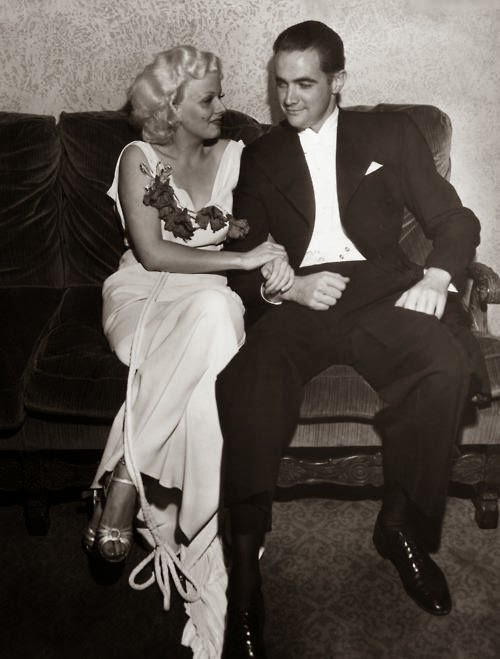
Jean Harlow and Howard Hughes at the premiere of HELL'S ANGELS.


A number of movie stars may ben seen in this film of the premiere, including Wheeler and Woolsey, Buster Keaton, Joe E. Brown, Sally Eilers, and Hoot Gibson.


Watch the complete movie at https://archive.org/details/HellsAngels1930JeanHarlow


HELL'S ANGELS:
http://news.google.com/newspapers?nid=950&dat=19280725&id=O99PAAAAIBAJ&sjid=l1QDAAAAIBAJ&pg=4158,5050864

http://www.nytimes.com/movie/review?res=9904E7DF1338E433A25755C1A96E9C946194D6CF


A