| Lucille Ball |
|---|

Ball in 1941
|
| Born | Lucille Désirée Ball
(1911-08-06)August 6, 1911
Jamestown, New York, U.S. |
|---|
| Died | April 26, 1989(1989-04-26) (aged 77)
Beverly Hills, California |
|---|
| Cause of death | Abdominal aortic dissection |
|---|
| Other names | Lucille Ball Morton
Lucille Ball Arnaz
Diane Belmont
Lucy Ball
Lucy Arnaz
Lucy Morton |
|---|
| Occupation | Actress, comedienne, model, film studio executive, TV producer, singer |
|---|
| Years active | 1932–1989 |
|---|
| Spouse(s) |
|
|---|
| Children | Lucie Arnaz
Desi Arnaz Jr. |
|---|
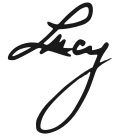
| Signature |
|---|
 |
Lucille Désirée Ball (August 6, 1911 – April 26, 1989) was an American actress, comedienne, model, film studio executive, TV producer and singer. She was the star of the sitcoms
I Love Lucy,
The Lucy–Desi Comedy Hour,
The Lucy Show,
Here's Lucy, and
Life with Lucy.
[1]
Ball's career in the spotlight began in 1929, when she landed work as a model. Shortly thereafter, Lucille began her performing career on
Broadway using the
stage name Diane Belmont and Dianne Belmont. She performed many small movie roles in the 1930s and 1940s as a contract player for
RKO Radio Pictures, being cast as a chorus girl, or in similar roles, and was dubbed the "Queen of the Bs" (referring to her many roles in
B-films).
[citation needed]. In the midst of her work as a control player for RKO, Ball met Cuban
bandleader Desi Arnaz. The two
eloped on November 30, 1940.
During the 1950s, Lucille Ball became a television star. In 1951, Ball and Arnaz created the television series
I Love Lucy, a show that would go on to be one of the most beloved programs in television history. On July 17, 1951, at almost forty years of age, Ball gave birth to their first child,
Lucie Désirée Arnaz.
[2] A year and a half later, she gave birth to their second child,
Desiderio Alberto Arnaz IV, known as Desi Arnaz, Jr.[3] Ball and Arnaz divorced on May 4, 1960.
In 1962, Ball became the first woman to run a major
television studio,
Desilu. Her studio produced many successful and popular
television series, including
Mission: Impossible and
Star Trek.
[4] She continued making film and television appearances for most of the rest of her life, albeit without ever attaining the success she enjoyed in the 1950s.
Ball was nominated for an
Emmy Award thirteen times and won four times.
[5] In 1977, Ball was among the first recipients of the Women in Film
Crystal Award.
[6] She was the recipient of the
Golden Globe Cecil B. DeMille Award in 1979,
[7] the Lifetime Achievement Award from the
Kennedy Center Honors in 1986,
[8] and the Governors Award from the
Academy of Television Arts & Sciences in 1989.
[9]
On April 26, 1989, at the age of 77, Ball died of an
abdominal aortic dissection.
[10] At the time of her death, she had been married to
standup comedian Gary Morton, her business partner and second husband, for more than 27 years.
[11]
Early life
Ball was born in
Jamestown, New York, in the
far western part of the state, the daughter of Désirée "DeDe" Evelyn (née Hunt; September 21, 1892 – July 20, 1977) and Henry Durrell Ball (September 16, 1887 – February 28, 1915). Ball and her family, following her father's death in 1915, moved to nearby
Celoron and lived there as a child with her grandparents. She later sometimes claimed she had been born in
Butte, Montana.
[12]
A number of magazines reported inaccurately that she had decided that Montana was a more romantic place to be born than New York and repeated a fantasy of a “Western childhood”; in fact, her father had moved the family there briefly for work, among other places.
[13] Her family was
Baptist, and her ancestry included
Scottish,
French,
Irish, and
English. Some of her genealogy leads to the earliest settlers in the colonies, including Englishman
Edmund Rice, an early immigrant to
Massachusetts Bay Colony.
[16][17]
Her father, a telephone
lineman for
Bell Telephone Company, was frequently transferred because of his occupation. Within three years of her birth, Lucille had moved with her parents from Jamestown to
Anaconda, and then to
Trenton.
[18] While DeDe Ball was pregnant with her second child,
Frederick, Henry Ball contracted
typhoid fever and died in February 1915. Ball recalled little from the day her father died, but remembered a bird getting trapped in the house. From that day forward, she suffered from
ornithophobia.
After her father died, her mother returned to New York and her parents. Ball and her brother, Fred Henry Ball (July 17, 1915 – February 5, 2007), were raised by their mother and maternal grandparents in
Celoron, New York, a summer resort village on
Lake Chautauqua, just west of Jamestown.
[21] Lucy loved Celoron Park, one of the best amusement areas in the United States at that time. Its boardwalk had a ramp to the lake as a children’s slide, the Pier Ballroom, roller-coaster, bandstand, and a stage where vaudeville, concerts, and regular theatrical shows were presented, all making the Park an entertainment destination.
[13] Her grandfather, Fred Hunt, was an eccentric who also enjoyed the theater. He frequently took the family to
vaudeville shows and encouraged young Lucy to take part in both her own and school plays.
[citation needed]
Four years after the death of her father, Ball’s mother DeDe remarried, to Edward Peterson. While her mother and stepfather looked for work in another city, Ball and her brother were cared for by her stepfather’s parents. Ball’s new guardians were a
puritanical Swedish couple who banished all mirrors from the house except for one over the bathroom sink. When the young Ball was caught admiring herself in it, she was severely chastised for being vain. This period of time affected Ball so deeply that in later life she claimed that it lasted seven or eight years. Peterson was a
Shriner. When his organization needed female entertainers for the
chorus line of their next show, he encouraged his twelve-year-old stepdaughter to audition. While Ball was onstage, she realized performing was a great way to gain praise and recognition. Her appetite for recognition had thus been awakened at an early age. In 1927 her family suffered misfortune. Their house and furnishings were lost to settle a financial
legal judgment, after a neighborhood boy was accidentally shot and paralyzed by someone
target shooting in their yard under Ball's grandfather's supervision. The family moved into a small apartment in Jamestown.
Career
Teenage years and early career
In 1925 Ball, then only 14, started dating Johnny DeVita, a 23-year-old local hood. DeDe was unhappy with the relationship, but was unable to influence her daughter to end it. She expected the romance to burn out in a few weeks, but that did not happen. After about a year, DeDe tried to separate them by using Lucille's desire to be in show business. Despite the family's meager finances, she arranged for Lucille to go to the
John Murray Anderson School for the Dramatic Arts in New York City, where
Bette Davis was a fellow student. Ball later said about that time in her life, "All I learned in drama school was how to be frightened."
Ball was determined to prove her teachers wrong and returned to New York City in 1928. Among her other jobs, she landed work as a fashion model for
Hattie Carnegie. Her career was thriving when she became ill, either with
rheumatic fever,
rheumatoid arthritis, or an unknown illness, and was unable to work for two years.
[31] She moved back to New York City in 1932 to resume her pursuit of a career as an actress and supported herself by again working for Carnegie and as the
Chesterfield cigarette girl. Using the name Diane (sometimes spelled Dianne) Belmont, she started getting some chorus work on Broadway but the work was not lasting. Ball was hired – but then quickly fired – by theatre
impresario Earl Carroll, from his
Vanities, and by
Florenz Ziegfeld, from a touring company of
Rio Rita.
[34] She was let go from the
Shubert brothers production of
Stepping Stones.
[citation needed]
Hollywood
After an uncredited stint as a
Goldwyn Girl in
Roman Scandals (1933), starring
Eddie Cantor and
Gloria Stuart, Ball moved permanently to Hollywood to appear in films. She appeared in many small movie roles in the 1930s as a contract player for
RKO Radio Pictures, including a two-reel comedy short with the
Three Stooges (
Three Little Pigskins, 1934) and a movie with the
Marx Brothers (
Room Service, 1938). She can also be seen as one of the featured models in the
Fred Astaire and
Ginger Rogers film
Roberta (1935), briefly as the flower girl in
Top Hat (1935), as well as in a brief
supporting role at the beginning of
Follow the Fleet (1936),
[35] another Astaire-Rogers film. Ginger Rogers was a distant maternal cousin of Ball's. She and Rogers played aspiring actresses in the film
Stage Door (1937), co-starring
Katharine Hepburn.
In 1936 she also landed the role she hoped would lead her to Broadway, in the
Bartlett Cormack play
Hey Diddle Diddle, a comedy set in a
duplex apartment in Hollywood. The play premiered in
Princeton,
New Jersey, on January 21, 1937 with Ball playing the part of Julie Tucker, "one of three roommates coping with neurotic directors, confused executives, and grasping stars who interfere with the girls' ability to get ahead."
[36] The play received good reviews, but there were problems, chiefly with its star,
Conway Tearle, who was in poor health. Cormack wanted to replace him, but the producer,
Anne Nichols, said the fault lay with the character and insisted that the part needed to be reshaped and rewritten. The two were unable to agree on a solution. The play was scheduled to open on Broadway at the
Vanderbilt Theatre, but closed after one week in Washington, D.C. when Tearle suddenly became gravely ill.
Ball was signed to
Metro-Goldwyn-Mayer in the 1940s, but she never achieved major stardom from her appearance in the studio's films.
[38] She was known in many Hollywood circles as "Queen of the B's" – a title previously held by
Fay Wray – starring in a number of
B-movies, such as
Five Came Back (1939). Like many budding actresses Ball picked up radio work to earn side income as well as gain exposure. In 1937 she appeared regularly on
The Phil Baker Show.
When that completed its run in 1938, Ball joined the cast of
The Wonder Show starring
Jack Haley (best remembered as the
Tin man in
The Wizard of Oz, 1939). It was here that she began her fifty-year professional relationship with
Gale Gordon, who served as show announcer.
The Wonder Show lasted one season, with the final episode airing on April 7, 1939.
[39] MGM producer
Arthur Freed purchased the Broadway hit musical play
DuBarry Was a Lady (1943) especially for
Ann Sothern, but when Sothern turned down the part the choice role was awarded to Ball, who in real life was Sothern's best friend. In 1946 Ball starred in
Lover Come Back and, in 1948, made an uncredited appearance as Sally Elliot in
The Fuller Brush Man.
I Love Lucy and Desilu

A scene from "Lucy Goes to Scotland", 1956
In 1948, Ball was cast as Liz Cugat (later "Cooper"), a wacky wife, in
My Favorite Husband, a radio program for
CBS Radio. The program was successful, and CBS asked her to develop it for television. She agreed, but insisted on working with her real-life husband, Cuban bandleader
Desi Arnaz. CBS executives were reluctant, thinking the public would not accept an All-American redhead and a Cuban as a couple. CBS was initially not impressed with the pilot episode produced by the couple's
Desilu Productions company, so the couple toured the road in a
vaudeville act with Lucy as the zany housewife wanting to get in Arnaz's show. The tour was a great success, and CBS put
I Love Lucy into their lineup.
[40] The
I Love Lucy show was not only a star vehicle for Lucille Ball, but a way for her to try to salvage her marriage to Desi Arnaz, which had become badly strained, in part by both having hectic performing schedules which often kept them apart.
Along the way, she created a television dynasty and reached several "firsts." Ball was the first woman in television to be head of a production company: Desilu, the company that she and Arnaz formed. After their divorce, Ball bought out Arnaz's share of the studio, and she proceeded to function as a very active studio head.
[41] Desilu and
I Love Lucy pioneered a number of methods still in use in television production today such as filming before a
live studio audience with a number of cameras, and distinct
sets adjacent to each other.
[42] During this time Ball taught a thirty-two week
comedy workshop at the
Brandeis-Bardin Institute. Ball was quoted as saying, "You cannot teach someone comedy; either they have it or they don't."
Ball and Arnaz wanted to remain in their Los Angeles home, but the
time zone logistics made that broadcast norm impossible. Prime time in L.A. was too late at night on the
East Coast to air a major network series, meaning the majority of the TV audience would be seeing not only the inferior picture of
kinescopes but seeing them at least a day later.
[44]
Sponsor
Philip Morris did not want to show day-old kinescopes to the major markets on the East Coast, yet neither did they want to pay for the extra cost that filming, processing, and editing would require, pressuring Ball and Arnaz to relocate to New York City. Ball and Arnaz offered to take a pay cut to finance filming, on the condition that their company, Desilu, would retain the rights to that film once it was aired. CBS relinquished the show rights to Desilu after initial broadcast, not realizing they were giving away a valuable and durable asset. In 1957, CBS bought the rights back for one million dollars, which provided Ball and Arnaz the down payment for the purchase of the former
RKO Studios, which became Desilu Studios.
[45]
I Love Lucy dominated the ratings in the United States for most of its run. (There was an attempt to adapt the show for radio; the cast and writers adapted the memorable "Breaking the Lease" episode — in which the Ricardos and Mertzes fall out over an argument, the Ricardos threaten to move, but they're stuck in a firm lease — for a radio audition disc that never aired but has survived.)
[46] A scene in which Lucy and Ricky are practicing the
tango, in the episode "Lucy Does The Tango", evoked the longest recorded studio audience laugh in the history of the show; so long that the
sound editor had to cut that particular part of the soundtrack in half.
[47] During the show's production breaks they starred together in two feature films:
The Long, Long Trailer (1954) and
Forever, Darling (1956). Desilu produced several other popular shows, such as
The Untouchables,
Star Trek, and
Mission: Impossible. Desilu was eventually sold for $17,000,000 and merged into
Paramount Pictures in 1967.
[48]
Later career
The 1960 Broadway musical
Wildcat ended its run early when Ball became too ill to continue in the show. The show was the source of the song she made famous, "Hey, Look Me Over," which she performed with Paula Stewart on
The Ed Sullivan Show. She made a few more movies including
Yours, Mine, and Ours (1968), and the musical
Mame (1974), and two more successful long-running sitcoms for CBS:
The Lucy Show (1962–68), which costarred Vivian Vance and
Gale Gordon, and
Here's Lucy (1968–74), which also featured Gordon, as well as Lucy's real life children, Lucie Arnaz and Desi Arnaz, Jr. She appeared on the
Dick Cavett show in 1974 and spoke of her history and life with Arnaz. She revealed how she felt about other actors and actresses as well as her love for Arnaz. Ball revealed in this interview that the strangest thing to ever happen to her was after she had some dental work completed and having lead fillings put in her teeth, she started hearing radio stations in her head. She explained that going home one night from the studio, as she passed one area, she heard what she thought was
morse code or a "tapping". She stated that "as I backed up it got stronger. The next morning, I reported it to the authorities and upon investigation, they found a Japanese
radio transmitter that had been buried and was actively transmitting codes back to the Japanese."
[51]
Ball was originally considered by
Frank Sinatra for the role of Mrs. Iselin in the Cold War thriller
The Manchurian Candidate. Director/producer
John Frankenheimer, however, had worked with
Angela Lansbury in a mother role in
All Fall Down and insisted on having her for the part.
[52]
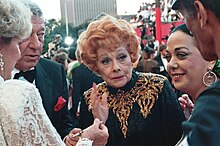
Ball at her last public appearance at the
61st Academy Awards in 1989, four weeks before her death. Ball's husband
Gary Morton can be seen on the left side of the photograph.
During the mid-1980s, Ball attempted to resurrect her television career. In 1982 she hosted a two-part
Three's Company retrospective, showing
clips from the show's first five seasons, summarizing memorable plotlines, and commenting on her love of the show.
[53] A 1985 dramatic made-for-TV film about an elderly homeless woman,
Stone Pillow, received mixed reviews. Her 1986 sitcom comeback
Life With Lucy, costarring her longtime
foil Gale Gordon and co-produced by Ball, Gary Morton, and prolific producer/former actor
Aaron Spelling was canceled less than two months into its run by
ABC.
[54] In February 1988, Ball was named the Hasty Pudding Woman of the Year.
[55]
In May 1988 Ball was hospitalized after suffering a mild heart attack.
[56] Her last public appearance, just one month before her death, was at the 1989
Academy Awards telecast in which she and fellow presenter, Bob Hope, were given a standing ovation.
Testimony before the House Committee on Un-American Activities
When Ball registered to vote in 1936, she listed her party affiliation as Communist.
[57] (She was registered as a Communist in 1938 as well.)
[58] In order to sponsor the
Communist Party's 1936 candidate for the
California State Assembly's
57th District, Ball signed a certificate stating "I am registered as affiliated with the Communist Party."
[59] The same year, she was appointed to the State
Central Committee of the Communist Party of California, according to records of the
California Secretary of State. In 1937, Hollywood writer
Rena Vale, a self-identified former Communist, attended a Communist Party new members' class at Ball's home, according to Vale's testimony before the
United States House of Representatives' Special
Committee on Un-American Activities, on July 22, 1940.
[60] Two years later, Vale reaffirmed this testimony in a sworn deposition:
"Within a few days after my third application to join the Communist Party was made, I received a notice to attend a meeting on North Ogden Drive, Hollywood; although it was a typed, unsigned note, merely requesting my presence at the address at 8 o'clock in the evening on a given day, I knew it was the long-awaited notice to attend Communist Party new members classes ... on arrival at this address I found several others present; an elderly man informed us that we were the guests of the screen actress, Lucille Ball, and showed us various pictures, books and other objects to establish that fact, and stated she was glad to loan her home for a Communist Party new members class."
Affidavit of Rena M. Vale, November 23, 1942. Joint Fact-Finding Committee on Un-American Activities in California.
In a 1944
British Pathé newsreel, titled
Fund Raising For Roosevelt, Ball was featured prominently among several stage and film stars at a fund-raising event in support of Democratic President
Franklin D. Roosevelt's campaign for
re-election.
[61] She stated that in the
1952 US Presidential Election, she voted for
Republican Dwight Eisenhower.
[62]
On September 4, 1953, Ball met privately with
HUAC investigator William A. Wheeler in Hollywood and gave him sealed testimony. She stated that she had registered to vote as a Communist "or intended to vote the Communist Party ticket" in 1936 at her socialist grandfather's insistence.
[63] She stated she "at no time intended to vote as a Communist."
Ball stated she has never been a member of the Communist Party "to her knowledge" ... [She] did not know whether or not any meetings were ever held at her home at 1344 North Ogden Drive; stated... [that if she had been appointed] as a delegate to the State Central Committee of the Communist Party of California in 1936 it was done without her knowledge or consent; [and stated that she] did not recall signing the document sponsoring EMIL FREED for the Communist Party nomination to the office of member of the assembly for the 57th District...
A review of the subject's file reflects no activity that would warrant her inclusion on the Security Index.[64]
J. Edgar Hoover, then director of the FBI, named "Lucy and Dezi [sic]" among his "favorites of the entertainment world."
[65] Immediately before the filming of episode 68 ("The Girls Go Into Business") of
I Love Lucy, Desi Arnaz, instead of his usual audience warm-up, told the audience about Lucy and her grandfather. Reusing the line he had first given to
Hedda Hopper in an interview, he quipped: "The only thing red about Lucy is her hair, and even that is not legitimate."
[66]
Personal life
Marriage, children, and divorce
In 1940, Ball met Cuban-born bandleader
Desi Arnaz while filming the
Rodgers and Hart stage hit
Too Many Girls. When they met again on the second day, the two connected immediately and eloped the same year. Although Arnaz was drafted into the
Army in 1942, he ended up being classified for limited service due to a knee injury.
[67] As a result, Arnaz stayed in Los Angeles, organizing and performing
USO shows for wounded
GI's being brought back from the Pacific. That same year, Ball appeared opposite
Henry Fonda in
The Big Street, in which she plays a paralyzed nightclub singer and Fonda portrays a
busboy who idolizes her. The following year Ball appeared in
DuBarry Was a Lady, a film for which the natural brunette first had her hair dyed the flaming red that would become her screen trademark.
[citation needed]
Ball originally filed for divorce in 1944, going so far as obtaining an
interlocutory decree; however, she reconciled with Arnaz and stopped the proceedings.
[68] Even though the couple were only six years apart in age, many apparently believed that it was less socially acceptable for an
older woman to marry a younger man, and hence split the difference in their ages, both claiming a 1914 birth date until this was disproved some years later.
[citation needed]
On July 17, 1951, one month before her 40th birthday, Ball gave birth to her first child,
Lucie Désirée Arnaz.
[2] A year and a half later, Ball gave birth to her second child,
Desiderio Alberto Arnaz IV, known as Desi Arnaz, Jr.
[3] Before he was born,
I Love Lucy was a solid ratings hit, and Ball and Arnaz wrote the pregnancy into the show. (Ball's necessary and planned
caesarean section in real life was scheduled for the same date that her television character gave birth.)
[3] There were several challenges from CBS, insisting that a pregnant woman could not be shown on television, nor could the word "pregnant" be spoken on-air. After approval from several religious figures
[69] the network allowed the pregnancy storyline, but insisted that the word "expecting" be used instead of "pregnant." (Arnaz garnered laughs when he deliberately mispronounced it as "'spectin'".)
[70] The episode's official title was "Lucy Is Enceinte," borrowing the French word for pregnant;
[18] however, episode titles never appeared on the show. The country was in an uproar over Lucy’s approaching delivery through the winter of 1952. Even the coverage of
Dwight D. Eisenhower’s winning the
1952 U.S. presidential election had to battle for media time against Lucy's special event. On January 14, 1953, reports flew around that baby Ricardo would be born on the following Monday’s show. Thousands called the studio and the Hollywood Press Office, demanding to know the details. January 19 would be a date to be remembered in the records of television history. Eisenhower’s swearing-in ceremony had an audience of 29 million people, while 44 million watched Lucy Ricardo welcome little Ricky.
[13] The birth made the first cover of
TV Guide for the week of April 3–9, 1953. Lucy appeared on the cover of
TV Guide more times than any other star in the history of the magazine.
[71]
In October 1956, Ball,
Vivian Vance, Desi Arnaz, and
William Frawley all appeared on a
Bob Hope special on
NBC, including a spoof of
I Love Lucy, the only time all four stars were together on a color
telecast. By the end of the 1950s, Desilu had become a large company, causing a good deal of stress for both Ball and Arnaz; his increased drinking further compounded matters.
[citation needed]
On March 3, 1960, a day after Desi's forty-third birthday (and one day after the filming of Lucy and Desi's last episode together), Lucy filed papers in Santa Monica Superior Court, claiming married life to Desi was "a nightmare" and nothing at all like it appeared on
I Love Lucy.
[72]
On May 4, 1960, just two months after filming that episode (the final episode of
The Lucy-Desi Comedy Hour), the couple divorced. Until his death in 1986, however, Arnaz and Ball remained friends and often spoke very fondly of each other. Her real-life divorce indirectly found its way into her later television series, as she was always cast as an unmarried woman.
[73][74]
The following year, Ball starred in the Broadway musical
Wildcat, which co-starred
Keith Andes and
Paula Stewart. That marked the beginning of a thirty-year friendship between Lucy and Stewart, who introduced Lucy to second husband
Gary Morton, a
Borscht Belt comic who was thirteen years her junior.
[11] According to Ball, Morton claimed he had never seen an episode of
I Love Lucy due to his hectic work schedule. Ball immediately installed Morton in her production company, teaching him the television business and eventually promoting him to producer. Morton played occasional bit parts on Ball's various series.
Ball was outspoken against the relationship her son had with
Patty Duke. Talking about Duke dating her son, she was quoted as saying, "I miss Patty, but you cannot domesticate Patty."
Ball's close friends in the business included perennial co-star
Vivian Vance as well as film stars
Ann Sothern and
Ginger Rogers, and comedic television performers
Mary Wickes and
Mary Jane Croft; all appeared at least once on her various series. Former Broadway co-stars Andes and Stewart also appeared at least once on her later sitcoms. Ball mentored actress and singer
Carole Cook, and befriended
Barbara Eden, when Eden appeared on an episode of
I Love Lucy.
Death
On April 18, 1989, Ball was at her home in Beverly Hills when she complained of chest pains. An ambulance was called and she was rushed to the emergency room of
Cedars-Sinai Medical Center. She was diagnosed with
dissecting aortic aneurysm and underwent
heart surgery for nearly eight hours, receiving an aorta from a 27-year-old man who had died in a motorcycle accident. The surgery appeared to have been successful, and Ball began recovering very quickly, even walking around her room with little assistance. She received a flurry of get-well wishes from Hollywood, and across the street from Cedars-Sinai Medical Center, the
Hard Rock Café erected a sign reading "Hard Rock Loves Lucy". However, shortly after dawn on April 26, Ball awoke with severe back pains and soon lost consciousness.
[78][79] All attempts to revive her proved unsuccessful, and she died at 05:47
PDT. Doctors determined that the 77-year-old comedian had succumbed to a second aortic rupture, this time in the abdominal area, and that it was unrelated to her surgery the previous week.
[80][81] Her body was cremated and the ashes were initially interred in
Forest Lawn – Hollywood Hills Cemetery in Los Angeles. However, in 2002, her children moved her remains to the family plot at Lake View Cemetery in
Jamestown, New York, where Ball's parents, brother, and grandparents are interred.
[82][83]
Legacy

The Lucille Ball Little Theatre in Ball's hometown of Jamestown, New York
On February 8, 1960, Ball was awarded two stars on the
Hollywood Walk of Fame: one at 6436 Hollywood Boulevard for contributions to motion pictures, and one at 6100 Hollywood Boulevard for television.
[84]
Ball received many prestigious awards throughout her career including some
posthumously such as the
Presidential Medal of Freedom by President
George H. W. Bush on July 6, 1989,
[85] and The Women's International Center's 'Living Legacy Award'.
[86]
There is a
Lucille Ball-Desi Arnaz Center museum in Lucy's hometown of Jamestown, New York. The Little Theatre was renamed the Lucille Ball Little Theatre in her honor.
[87] Ball was among
Time magazine's "100 Most Important People of the Century."
[88]
On June 7, 1990,
Universal Studios Florida opened a walk-through attraction dedicated to Lucille, named "Lucy - A Tribute", which features clips of shows, as well as various pieces of trivia about Lucille, along with items owned by or associated with Lucille, and an interactive quiz for guests.
[89]
On August 6, 2001, which would have been her 90th birthday, the
United States Postal Service honored her with a
commemorative postage stamp as part of its Legends of Hollywood series.
[90] Ball appeared on the cover of
TV Guide more than any other person; she appeared on thirty-nine covers, including the very first cover in 1953 with her baby son, Desi Arnaz, Jr.
[91] TV Guide voted Lucille Ball as the 'Greatest TV Star of All Time' and it later commemorated the fiftieth anniversary of
I Love Lucy with eight collector covers celebrating memorable scenes from the show. In another instance it named
I Love Lucy the second-best television program in American history, after
Seinfeld. Because of her liberated mindset and approval of the
Women's Movement, Ball was inducted into the
National Women's Hall of Fame in 2001.
[93]
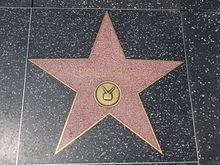
Ball's Hollywood Walk of Fame star for her television work
The
Friars Club named a room in its New York clubhouse for Lucille Ball.
[94] She was awarded the 'Legacy of Laughter' award at the fifth Annual
TV Land Awards in 2007.
[95] I Love Lucy was named the 'Greatest TV Series' by
Hall of Fame Magazine[citation needed]. In November 2007, Lucille Ball was chosen as the second out of the '50 Greatest TV Icons', after
Johnny Carson. In a poll done by the public, however, they chose her as the greatest icon.
[96]
On August 6, 2011, which would have been her 100th birthday,
Google honored Ball with an interactive
doodle on their homepage. This doodle displayed six classic moments from
I Love Lucy.
[97] On the same day a total of 915 Ball look-alikes converged on
Jamestown, New York, to celebrate the birthday and set a new world record for such a gathering.
[98]
Since 2009, a statue of Ball has been on display in Celeron, New York, where residents have deemed it "scary". The artist has discussed fixing the statue with town officials, but claimed they wanted him to do it at his own expense. In 2015, Celeron's mayor said the town is looking to hire a different artist instead.
[99] In 2015
@midnight, which uses the same studio where
I Love Lucy was shot, is mounting a campaign to purchase the statue and "bring it home."
[100]
Filmography and television work
Radio appearances
References
- Jump up ^ "Lucille Ball Bio". tv.com. Retrieved April 2, 2008.
- ^ Jump up to: a b "Lucie Arnaz Filmography". Fandango. Retrieved April 5, 2008.
- ^ Jump up to: a b c "Lucille Ball Timeline and Biography". twoop.com. Retrieved April 5, 2008.
Ball gives birth to her children
- Jump up ^ "Arnaz Quits Presidency Of Desilu; Former Wife, Lucille Ball, Gets Post", Wall Street Journal, November 9, 1962, p. 18.
- Jump up ^ "Lucille Ball: Biography". punoftheday.com. Retrieved April 2, 2008.
Ball wins four Emmys and nominated for a total of 13
- Jump up ^ "Past Recipients: Crystal Award". Women In Film. Retrieved May 10, 2011.
- Jump up ^ "The Cecil B. DeMille Award". Hollywood Foreign Press Association. Retrieved March 10, 2012.
- Jump up ^ "List of Kennedy Center Honorees". Kennedy-center.org. Retrieved March 10, 2012.
- Jump up ^ "Hall of Fame Archives: Inductees". Academy of Television Arts & Sciences. Retrieved March 10, 2012.
- Jump up ^ "Lucille Ball". Morbid Curiosity. Retrieved April 6, 2008.
Lucille Ball is recovering and dies
- ^ Jump up to: a b Sanders & Gilbert 1993, p. 216.
- Jump up ^ "Time Life". Time. Archived from the original on April 6, 2008. Retrieved April 2, 2008About Lucille Ball's relatives
- ^ Jump up to: a b c Higham , C. (1986). Lucy: The life of Lucille Ball, New York: St. Martin's Press.
- Jump up ^ "Some Ancestral Remains of Lucille Ball by Lois Barris". Rootsweb.com. Retrieved October 6, 2012.
- Jump up ^ "Isaac Ball (1747- ?)". Edmund Rice (1638) Association. Lucille Desiree Ball (1911–1989) was a descendant of Edmund Rice as follows: Edmund Rice (1594–1663); Henry Rice (1617–1711); Elizabeth Rice (1648–1740); Mary Brewer (1680–?); Isaac Ball (? –1789); Isaac Ball (1747–1790); Isaac Ball (1787–1865); Clinton Manross Ball (1817–1893); Jasper Clinton Ball (1852–933); Henry Durell Ball (1887–1915) and Lucille Désirée Ball (1911–1989). Retrieved May 13, 2012.
- ^ Jump up to: a b Interview with Lucille Ball on the Dick Cavett Show on YouTube. 1974.
- Jump up ^ "Lucille Ball Biography". Encyclopedia of World Biography. Retrieved April 5, 2008.
- Jump up ^ "Lucille Ball Trivia". NetGlimse. Retrieved March 14, 2012.
- Jump up ^ "Lucille Ball at Hollywood.com". Hollywood.com. Archived from the original on January 26, 2013. Retrieved April 2, 2008.
Lucille Ball's stage name
- Jump up ^ "Lucille Ball". Everything2.com. Retrieved April 5, 2008.
Ball and Rogers are lifelong friends
- Jump up ^ Brady, Kathleen (2001). Lucille: The Life of Lucille Ball. Random House Digital, Inc. p. 73. ISBN 978-0-8230-8913-0. Retrieved December 26, 2012.
- Jump up ^ Crouse, Richard J. (2003). The 100 Best Movies You've Never Seen. Toronto: ECW Press. p. 196. ISBN 1-55022-590-1.
"Stage Door" gives Ball her big break
- Jump up ^ ""The Wonder Show" – 1938 Radio Series – Starring Jack Haley, with Lucille Ball & Gale Gordon". The Wonder Show. Retrieved April 9, 2008.
Lucy and The Wonder Show
- Jump up ^ Silver, Allison (July 16, 2009). "Sotomayor: More 'Splainin' to Do". The Huffington Post. Retrieved June 18, 2010.
CBS executives originally did not want Ball, a sassy redhead, married to a Latino on the program
- Jump up ^ "American Masters "Lucille Ball: Finding Lucy"". PBS. Retrieved April 2, 2008.
Ball first woman to head a major studio
- Jump up ^ "Desi Arnaz". Lucille Ball Info. Retrieved April 2, 2008.
Arnaz revolutionizes television
- Jump up ^ Gehring, Wes (2001). ""I Love Lucy" Turns 50 – Lucille Ball, Desi Arnaz, background info on influential, groundbreaking TV comedy". USA Today (Society for the Advancement of Education). Retrieved April 5, 2008.
Arnaz did not want kinescope
- Jump up ^ Cushman, Marc; These Are the Voyages, Vol. 1; Jacobs/Brown Press; San Diego, CA, USA; 2013; p. 27
- Jump up ^ [1](mp3) – archive.org
- Jump up ^ Hofstede, David (2006). 5000 Episodes and No Commercials: The Ultimate Guide to TV Shows on DVD 2007. New York: Back Stage Books. p. 149. ISBN 0-8230-8456-6.
Longest laugh in television history
- Jump up ^ Cushman, Marc; These Are the Voyages, Vol. 2; Jacobs/Brown Press; San Diego, CA, USA; 2014; p. 307
- Jump up ^ "Brace Yourself". snopes.com. August 5, 2007. Retrieved June 14, 2011.
- Jump up ^ Frankenheimer's DVD audio commentary.
- Jump up ^ "TV Land March 2007 –To Be Continued Free Fridays; Three's Company 30th Anniversary – Sitcoms Online Message Boards". TV Land. Retrieved April 6, 2008.
Ball hosts Three's Company reflective
- Jump up ^ "Life With Lucy". TV Party. Retrieved April 6, 2008.
"Life With Lucy" turns out to be a flop
- Jump up ^ "Lucille Ball at Hasty Pudding". Ten O'Clock News, WGBH. February 19, 1988.
- Jump up ^ "Local News in Brief: Lucille Ball Recovering". Los Angeles Times. June 1, 1988.
- Jump up ^ "Index to Register of Voters". Ancestry.com. 1936. Retrieved March 14, 2012Copy of document from Los Angeles City Precinct No. 1598, Los Angeles County, CA
- Jump up ^ Ancestry.com (January 30, 2008). "New California Voter Registrations Reveal Celebrity Party Lines". Ancestry.com. Retrieved March 14, 2012.
- Jump up ^ Testimony of Lucille Désirée Ball Arnaz, September 4, 1953, Committee on Un-American Activities, House of Representatives, 83d Cong., 1st sess., Investigation of Communist Activities in the Los Angeles Area – Part 7, September 4, 1953 (Washington: United States Government Printing Office, 1953), p. 2567 (PDF p. 14)
- Jump up ^ FBI file, pp. 10–13: FBI memorandum: D.M. Ladd to Hoover, Subject: Lucille Ball, Dezi [sic] Arnaz, September 17, 1953.
- Jump up ^ Fundraising for Roosevelt (video newsreel film). Washington, DC: British Pathé. Retrieved June 14, 2011.
- Jump up ^ "Ball, Lucille". FunTrivia.com. Retrieved June 14, 2011.
- Jump up ^ Ball explained, "In those days that was not a big, terrible thing to do. It was almost as terrible to be a Republican in those days." Testimony of Lucille Désirée Ball Arnaz, September 4, 1953, Committee on Un-American Activities, House of Representatives, 83d Cong., 1st sess., Investigation of Communist Activities in the Los Angeles Area – Part 7, September 4, 1953 (Washington: United States Government Printing Office, 1953), p. 2571 (PDF p. 18)
- Jump up ^ FBI file, p. 24: FBI memorandum: SAC Los Angeles to Hoover, Subject: Lucille Ball, was., December 16, 1953. Cf. Sanders & Gilbert 2001, pp. 77–78.
- Jump up ^ FBI file, p. 32: copy of: Flaherty, Vincent X. (October 23, 1956). "Hoover Hits Crime Trends in Movies". Los Angeles Examiner.
- Jump up ^ Brioux, Bill (2007). Truth and Rumors: The Reality Behind Tv's Most Famous Myths. Greenwood Publishing Company. p. 37. Retrieved July 4, 2012.
- Jump up ^ "Arnaz, Desi". tcm.com. Retrieved July 17, 2014.
- Jump up ^ "Lucille Ball biography". Essortment.com. Retrieved April 5, 2008.
Ball and Arnaz patch things up before divorce became final
- Jump up ^ "Radio: Birth of a Memo". Time. January 26, 1953. Retrieved June 14, 2011.
- Jump up ^ "Celebrity Commercials in TV's Golden Age". Teletronic. Archived from the original on August 19, 2010. Retrieved April 5, 2008.
- Jump up ^ "Biography of Lucille Ball, famous TV clown". Lucille Ball Info. Retrieved April 5, 2008.
- Jump up ^ Andrews, Bart` (1976). Lucy and Ricky and Fred and Ethel. Toronto and Vancouver: Clarke, Irwin & Company Limited. p. 166.
- Jump up ^ "Powell's Books – Review-a-Day – Ball of Fire: The Tumultuous Life and Comic Art of Lucille Ball by Stefan Kanfer". The New Republic Online. Retrieved April 5, 2008.
Ball's real life divorce makes it into her new shows as showing her as a single woman
- Jump up ^ Kanfer 2003, pp. 72–84. "Ball and Arnaz remain friends".
- Jump up ^ "Article: Lucille Ball, Pioneer of Television Comedy, Dies at 77". Retrieved August 31, 2009.
- Jump up ^ Ball, Lucille (April 27, 1989). "Ball dies of ruptured aorta". L.A. Times. Retrieved May 12, 2013.
- Jump up ^ "The Death of Lucille Ball". findadeath.com. Retrieved April 14, 2015.
- Jump up ^ Ball, Lucille (April 27, 1989). "Lucy dies". Chicago Tribune. Retrieved May 12, 2013.
- Jump up ^ Staff. "Lucille Ball's Ashes Moved to Jamestown, New York". Lisa Burks. Retrieved May 12, 2013.
- Jump up ^ Lucille Ball at Find a Grave
- Jump up ^ "Walk of Fame: Lucille Ball".
- Jump up ^ "NATION: Lucille Ball Gets Medal of Freedom". Los Angeles Times. July 6, 1989. Retrieved May 22, 2011.
- Jump up ^ "Welcome to Women's International Center". Women's International Center. Retrieved April 9, 2008.
Living Legacy Award
- Jump up ^ "The Lucille Ball Little Theater of Jamestown, Inc.". Designsmiths. Retrieved April 9, 2008.
Renaming of the "Little Theater" in Jamestown, New York
- Jump up ^ "TIME 100 – People of the Century". Time Magazine. Retrieved April 9, 2008.
- Jump up ^ "Lucy - A Tribute". Universal Studios Orlando. Retrieved July 8, 2015.
- Jump up ^ "USPS – Stamp Release No. 01-057 – Legendary Hollywood Star Lucille Ball Honored on U.S. Postage Stamp". US Post Office. Archived from the original on January 19, 2008. Retrieved April 9, 2008.
Ball honored on a Postage Stamp
- Jump up ^ "Lucille Ball – Photos, Bio and News for Lucille Ball". TV Guide. Retrieved April 9, 2008.
Lucy appears on thirty-nine covers of TV guide
- Jump up ^ "National Women's Hall of Fame". Great Women Organization. Retrieved April 9, 2008.
Ball inducted into the National Women's Hall of Fame
- Jump up ^ "Lucille Ball Room". The Friars Club. Retrieved August 27, 2013.
- Jump up ^ "TV Land loves Lucy". Los Angeles Times. April 15, 2007. Retrieved May 10, 2007.
- Jump up ^ Associated Press (November 16, 2007). "Carson tops list of 50 greatest TV icons". MSNBC. Retrieved March 19, 2008.
- Jump up ^ Nancy Blair (August 6, 2011). "Google Doodle pays charming tribute to Lucille Ball on her 100th". USA Today. Retrieved August 6, 2011.
- Jump up ^ "915 Lucille Ball look-alikes set record", upi.com; accessed December 8, 2014.
- Jump up ^ Hunter, Marnie (April 7, 2015). "Mayor rejects artist's offer to fix 'Scary Lucy' statue". CNN. Retrieved April 8, 2015.
- Jump up ^ "We Must Bring Creepy LUCY Statue to Its Rightful Home: On @MIDNIGHT". Nerdist. Retrieved April 14, 2015.
- Jump up ^ "Those Were The Days". Nostalgia Digest 39 (2): 32–39. Spring 2013.
Citations – books
- Ball, Lucille (1996). Hoffman, Betty Hannah, ed. Love, Lucy. New York: Putnam. ISBN 978-0-399-14205-5. OCLC 231698725. This autobiography covers Ball's life up to 1964. It was discovered by her children in 1989 ("Love, Lucy". WorldCat. Retrieved November 19, 2011. )
- Brady, Kathleen (2001). Lucille: the life of Lucille Ball. New York: Billboard Books. p. 20. ISBN 0-8230-8913-4.
- Harris, Warren C. (1991). Lucy and Desi: the legendary love story of television’s most famous couple. New York: Simon & Schuster. ISBN 978-0-671-74709-1.
- Herringshaw, DeAnn (2011). Lucille Ball: Actress & Comedienne. Edina, MN: ABDO. ISBN 978-1-61787-664-6.
- Kanfer, Stefan (2003). Ball of Fire: The Tumultuous Life and Comic Art of Lucille Ball. New York: Alfred A. Knopf. ISBN 0-375-41315-4.
- Karol, Michael A. (2004). The Lucille Ball Quiz Book. United States: iUniverse. ISBN 978-0-595-31857-5.
- Sanders, Coyne Steven; Gilbert, Thomas W. (1993). Desilu: The Story of Lucille Ball and Desi Arnaz. HarperCollins. ISBN 978-0-688-13514-0.
- Sanders, Coyne Steven; Gilbert, Thomas W. (2001). Desilu: The Story of Lucille Ball and Desi Arnaz. New York: HarperEntertainment. ISBN 0-688-13514-5. OCLC 48543617.
Further reading
- Karol, Michael (2003). Lucy in Print; ISBN 0-595-29321-2
- Karol, Michael (2004). Lucy A to Z: The Lucille Ball Encyclopedia; ISBN 0-595-29761-7
- Karol, Michael (2005). The Comic DNA of Lucille Ball: Interpreting the Icon; ISBN 0-595-37951-6
- McClay, Michael (1995). I Love Lucy: The Complete Picture History of the Most Popular TV Show Ever; ISBN 0-446-51750-X (hardcover)
- Meeks, Eric G. (2011). P.S. I Love Lucy: The Story of Lucille Ball in Palm Springs. Horotio Limburger Oglethorpe. p. 45. ISBN 978-1468098549.
- Pugh Davis, Madelyn; with Carroll Jr., Bob (2005). Laughing With Lucy: My Life With America's Leading Lady of Comedy; ISBN 978-1-57860-247-6
- Sheridan, James & Barry Monush (2011). Lucille Ball FAQ: Everything Left to Know About America's Favorite Redhead; ISBN 978-1-61774-082-4
- Young, Jordan R. (1999). The Laugh Crafters: Comedy Writing in Radio & TV's Golden Age. Beverly Hills: Past Times Publishing; ISBN 0-940410-37-0 (interview with Bob Schiller)
External links


.jpg)
.jpg)


.jpg)

.jpg)
.jpg)


